ARE YOU EXPERIENCING CLAY DESICCANT INVENTORY ISSUES? WITH THE ARMOR SMARTY PAK – A COMBO OF VCI & DESICCANT — RUST PREVENTION IS “NO SWEAT”
The clay desiccant market has been volatile in the past two years. Pricing has gone up several times due to increases in the costs associated with the labor and mining of desiccant clay as well as increases in the cost of Tyvek paper used for its outer packaging. In addition, existing inventories of the desiccant have been depleted and new orders are met with extremely long lead times. But, amidst all this desiccant-related doom-and-gloom, there is a ray of hope – it’s the ARMOR SMARTY PAK™.
SMARTY PAKs are unique in that they are one-part emitter and one-part desiccant. They emit ARMOR VCI Nanotechnology™ (our “secret formula” for vapor corrosion inhibitor) to form a protective shield on the surface of metal and they adsorb moisture to remove it from the packaging or storage environment. This give-and-take feature is why the SMARTY PAK packs-a-punch in protecting metal parts.
If you’re looking for a clay desiccant alternative, the SMARTY PAK is a smart choice and here’s why. ARMOR uses a specialty desiccant in its SMARTY PAK design (different from clay desiccant and free from its supply issues) – this specialty desiccant not only adsorbs moisture faster than traditional desiccants, but it holds on to the moisture even at high temperatures.
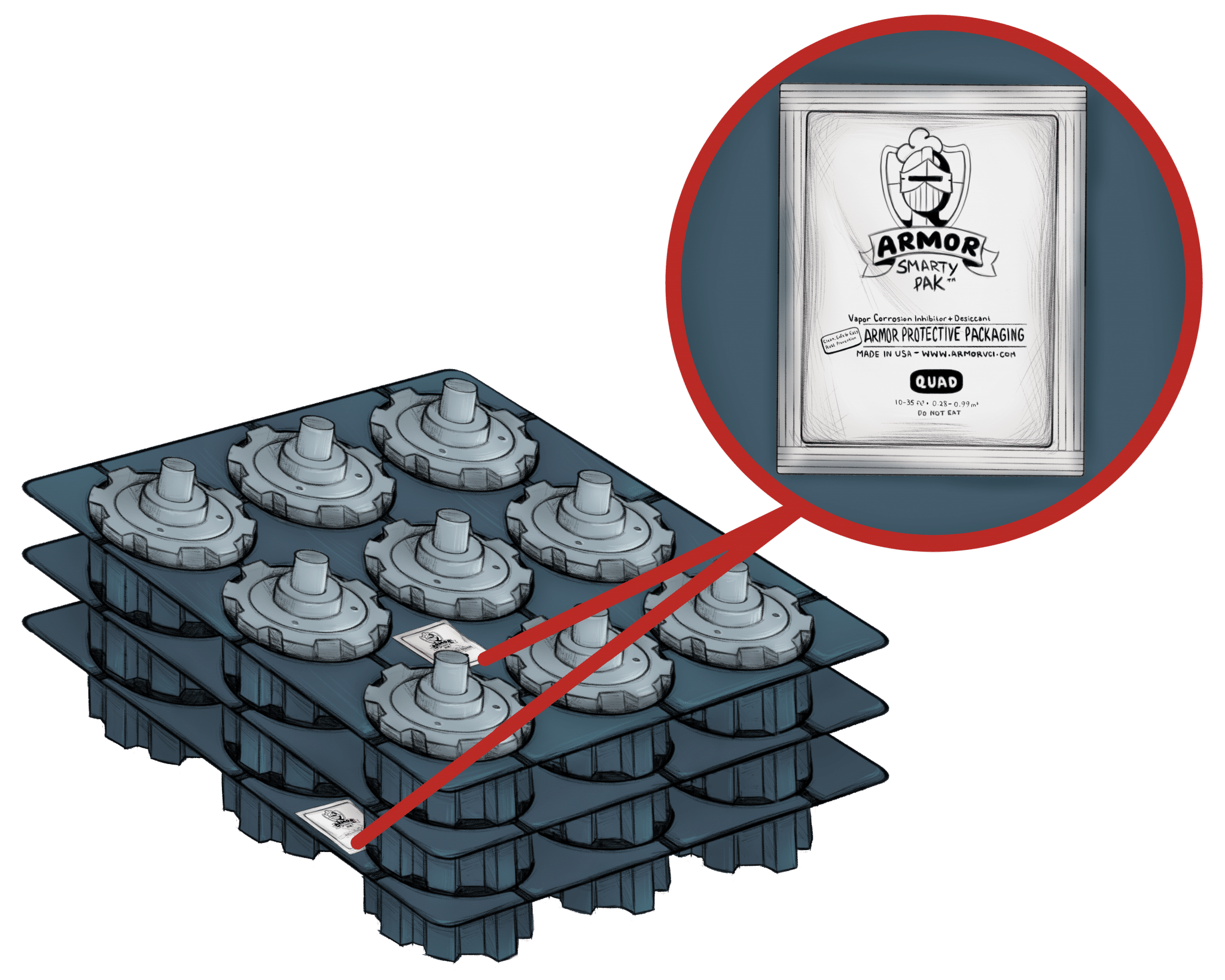
ARMOR developed the SMARTY PAK specifically for use in environments where both moisture control and vapor corrosion inhibitors (VCI) are required to adequately protect metal from rust. We call it the “deadly-duo of rust prevention” because the SMARTY PAK not only removes moisture and humidity, it also releases corrosion-inhibiting vapors to prevent rust.
SMARTY PAKs are available in three sizes, they deliver multi-metal protection, and they are non-dusting and lint-free making them ideal for use in applications where fibrous packaging materials are not allowed.
If you’re looking to protect metal parts during packaging, storage, transport or export, ARMOR SMARTY PAKs could be the rust-prevention solution needed to earn you the title of Smarty Pants!
For additional information on the ARMOR SMARTY PAK™ contact your local ARMOR representative.
Corrosion is far more than just a cosmetic issue. It is a challenge faced by many industries, from manufacturing to automotive. Rust can weaken metal parts or components causing safety issues and corroded metal parts can require reworking or replacement, which can be a costly drain on time and resources.
Consumers and manufacturers alike have a new awareness surrounding environmental sustainability – with this, has come an increased demand for more eco-friendly methods to prevent rust. The age-old, traditional methods of using hazardous oils, grease, or other protective coatings that cause harm to the environment must be eliminated. Sustainable rust prevention isn’t just about safeguarding metal surfaces; it’s about preserving our planet’s resources and protecting the environment.
That is why Armor Protective Packaging® continues to focus on sustainable rust prevention using our proprietary formula of vapor corrosion inhibitor (VCI) Nanotechnology™. We combine VCI with paper, or poly film, to create packaging materials that prevent rust. When metal parts are wrapped or enclosed in VCI packaging, the VCI releases special vapors that form a protective shield on the surface of the metal to keep it clean and corrosion-free. ARMOR VCI rust prevention products are clean, safe, easy to use, and easy on the environment.
Effective rust prevention offers many advantages beyond the obvious. While it keeps metal parts clean and corrosion-free, reducing the expense of rework and repair, the greater advantage is in prolonging the life of metal parts and eliminating the need for replacement.
Extending the life cycle of metal parts through rust prevention not only saves money and conserves the resources required to manufacture replacements, but it also plays an important role in promoting sustainability. Manufacturing new metal parts requires substantial natural resources and a large expenditure of energy. It requires the extraction of raw materials like iron and steel, which depletes finite resources and contributes to increased greenhouse gases and the carbon footprint. In addition, the energy expenditure involved in metal part production is huge — it takes roughly 6,950 kilowatt-hours of energy to produce 1 ton of iron from iron ore and that is equivalent to the electricity used by an average household for nearly 8 months.
Historically, rust prevention involved the messy and labor-intensive application of a layer of grease or oil to the surfaces of metal to serve as a physical barrier of protection. Vapor corrosion inhibitors (VCI), on the other hand, are a class of chemical compounds that emit corrosion-inhibiting molecules into an enclosed air space. The VCI vapors form a clean, dry molecular barrier that blocks moisture, oxygen, and its resulting rust. While hazardous grease and oil require cleaning and degreasing for removal, VCI dissipates once the metal is removed, leaving metal parts ready for immediate use. Better yet, VCI products save users and the environment from the immediate and long-term dangers of exposure to harmful chemicals.
When it comes to green and sustainable rust prevention, VCI packaging offers dual benefits — not only is it effective in protecting metal parts from the damage of corrosion, but it’s also eco-friendly. VCI is often combined with supplies such as Kraft paper or polyethylene film, to create packaging materials that also prevent rust. These materials can be manufactured using recycled content, which means they contain recycled material, lessening the environmental footprint of the VCI packaging. Many VCI packaging materials are also recyclable, allowing them to be reused to manufacture new products, and contributing to resource conservation.
Contact your local ARMOR representative.
Keeping metal parts clean and rust-free while they are in process, in storage, or in shipping and transport is a battle worth fighting. It can save a manufacturer the resources required to rework, scrap, or replace rusted parts and, in turn, save time, money, and reputation. The first step in preventing corrosion of metal parts is identifying the cause – most often, moisture, humidity, and condensation are at the top of the list. Desiccants are made of materials that remove moisture and humidity and they offer an easy solution to preventing the damage of rust and corrosion.
Desiccants are drying agents that are used to “trap” moisture and control humidity levels in an enclosed space such as packaging, boxes, totes, or shipping containers. They are made from hygroscopic substances such as silica, certain types of clay, or calcium chloride, that attract and hold moisture from the environment to create or maintain a state of dryness. These substances appear to have one solid surface, typically in the form of small beads, granules, crystals, or pellets. But, when they are magnified, you see that the surface of these drying agents is very porous, which explains why they can hold a large percentage of their weight in moisture.
Most desiccants work using adsorption, a process where moisture adheres to but does not penetrate, the porous surface of the desiccant. It’s like a magnet for moisture – when the surrounding environment is humid, the moisture in the air sticks to the surface of the desiccant like a magnet sticks to metal. In addition, a few desiccants do exist that operate through absorption (the process of a substance being drawn up or taken into the inner structure of an absorbent material) similar to a sponge, but they are less common.
Desiccants act as dehumidifiers; they adsorb excess moisture from the air and reduce humidity levels in an enclosed space. For metal parts packaged in boxes, bins, crates, or, shipping and storage containers, a desiccant can be essential to preserving their appearance and functionality. Desiccants ensure that metal parts remain in optimal condition and eliminate the expense of reworking or scrapping damaged metal parts or the need for additional rust-prevention interventions.
Desiccants are available in a variety of pre-packaged forms (packets, packs, pouches, bags) and sizes, making them simple to use. They can easily be placed directly into packaging or storage containers without special training or complicated instructions. Some of the most common uses of desiccant in keeping metal parts clean, dry, and rust-free include:
ARMOR offers several options to manage moisture, humidity, and the risk of damage due to corrosion that could threaten your metal parts or components. Take a look at ARMOR Shield® Desiccants and ARMOR’s exclusive VCI and desiccant combo, the SMARTY PAK™, or contact us to learn more about ARMOR desiccant products.
As a company, Armor Protective Packaging® is working hard to manufacture rust prevention packaging that is clean, safe and easy and just as hard to be an outstanding steward to our beautiful earth. We’re not claiming to have the “silver bullet” to save the environment, there is a long way to go for that, for all of us. What we are saying is that as a company, ARMOR wants to be part of the solution.
These days, there is so much talk on the environment and terms like “green” and “sustainable” are thrown around without explanation – it can all be quite confusing. At ARMOR, we want to be candidly clear, so we outlined 6 ways ARMOR goes green.
Recycling is one of the best ways to positively impact our environment and our human race. Recycling helps to reduce the pollution caused by waste and reduces the need for raw materials to be used. Huge amounts of energy are needed when making products from raw materials, while recycling requires much less energy and therefore preserves our natural resources. When finished using an ARMOR film or paper, recycle it!
ARMOR utilizes recycled content in our products whenever possible, and we do it without sacrificing their integrity or performance. As recycled resins continue to improve in cleanliness and recycling continues to gain more ground each year, utilizing recycled resin content makes enormous sense.
Since 2020, every formulation of ARMOR POLY® VCI film that is feasible contains a minimum of 30% recycled content (excluding those VCI films with heat shrink, UV and HD). The recycled content is comprised of post-industrial recycled materials, which are waste materials (such as scrap, trimmings, overruns) that are created during the original manufacturing process and are later reused to create new material. These are the same films we use for our VCI (vapor corrosion inhibitor) poly bags, sheeting and bonnets.
Recycling 1 ton of paper (such as ARMOR WRAP® VCI paper) saves 17 mature trees, 7,000 gallons of water, 3 cubic yards of landfill space, 2 barrels of oil and the energy equivalent of 165 gallons of gasoline.
Source reduction is one recommendation of waste management. In loose terms, source reduction (also known as waste prevention) means reducing/eliminating waste before it is created, and it is often used to describe the changes that businesses undertake voluntarily to reduce the potential waste material associated with a product.
In 2005, ARMOR was the first VCI manufacturer to use innovative engineering to bring multi-layer (co-extruded) films to the market with the debut of its DEFENDER™ film. ARMOR’s DEFENDER is a three-layer film that positions VCI on the inside, closest to metal parts – a strategic placement that reduces the quantity of VCI resin needed (without reducing performance). In addition, the DEFENDER’s middle and outer layers are constructed for superior barrier protection and durability and the result is a VCI film with 50 percent more barrier protection than comparable single-layer films allowing it to be down-gauged by 25-30% for savings in cost and resources.
ARMOR is optimistic that biodegradable plastics will become a viable option in the future, but the current industry and selection are just not there yet. Manufacturers who claim to make biodegradable or compostable plastics are often “greenwashing” – a marketing technique designed to falsely give the impression that a company is doing more to protect the environment than it really is. Many times, a company or organization is spending more time/money promoting it’s eco- or environmentally-friendly status than actually being eco- or environmentally friendly.
The terms biodegradable or compostable plastic lead people to think these films actually degrade and it promotes a ‘single use’ mentality. In reality, biodegradable polymer-based films require high temperature and sunlight to biodegrade, and these conditions are unrealistic given the current waste and composting systems. In addition, most of these “biodegradable” films are still made from petrochemicals with additional chemicals added to cause the plastic to break down to smaller pieces (if exposed to the right conditions) making them difficult to recycle. If these films enter the ocean, the smaller plastic pieces are easy to ingest and pose a serious threat to any wildlife and organisms that consume them.
ARMOR WRAP® VCI papers are both renewable and sustainable. Paper is a renewable resource (meaning it can be regenerated) made from wood, a natural resource that is renewable and recyclable.
ARMOR is no “late comer” to the “green movement,” we have always upheld a strict standard that ARMOR rust prevention/rust removal products are clean, safe and easy or they aren’t ARMOR. Whether it’s our rust-preventing VCI Nanotechnology™ (our “secret formula” for vapor corrosion inhibitors), or our innovative, water-based rust remover Metal Rescue®, ARMOR products eliminate the work, mess and hazards of RP oils, grease and solvent-based chemicals. ARMOR’s clean, safe and easy approach is good for people, good for the environment and just a good way to do business.
ARMOR VCI SEA Film™ is formulated to withstand Mother Nature’s most threatening outdoor conditions and to protect metal and metal parts from rust and corrosion that could form as a result.
SEA Film is constructed to protect metal in three ways:
1. It emits ARMOR’s proprietary VCI Nanotechnology™ (a.k.a., our “secret recipe” for vapor corrosion inhibitor), which form a corrosion-inhibiting shield to keep the surface of metal free from rust.
2. It acts as a physical barrier against the harshest of outdoor conditions.
3. SEA Film contains a UV-inhibiting package containing both a UV stabilizer and UV-resistant pigments to provide two-year protection from the damage of heat and exposure to UV light.
SEA Film’s high-grade protection is ideal for metal and metal parts exposed to the elements during outdoor storage or overseas transport and with its unique, multi-layer design it can often be down-gauged to reduce cost without compromising performance.
Click here for more information on Armor Sea Film
Looking for pricing or to place an order? Contact your local team today
Prevent rust with ARMOR DEFENDER™ VCI, our DEFENDER bags and films are designed for strength, longer-term protection and cost effectiveness.
The DEFENDER is a multi-layer film that positions ARMOR’s proprietary VCI Nanotechnology™ (a.k.a., our “secret recipe” for vapor corrosion inhibitor) on the inside layer of the film closest to the metal parts. This strategic placement and design reduces the quantity of VCI resin needed (without reducing performance) and offers customers savings in cost and resources!
The DEFENDER’s middle and outer layers are constructed for superior barrier protection, durability and puncture resistance and the result is a film with 50 percent more barrier protection than comparable single-layer films.
Simply put, whether your wrapping metal parts or sealing them in a VCI bag, ARMOR DEFENDER VCI provides high performance without the high cost.
As well as our most popular DEFENDER VCI BAG size: 51cm x 41cm x 76cm, 4ml, we also offer custom made options! Contact sales@armorvci.com.au for more info.
DEFENDER BENEFITS
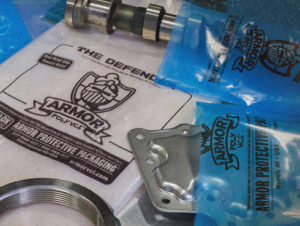
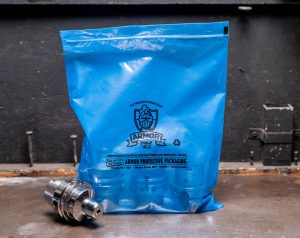
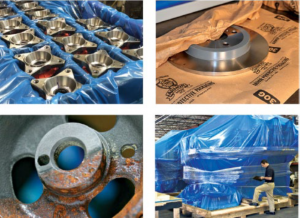
As well as our most popular DEFENDER VCI BAG size: 51cm x 41cm x 76cm, 4ml, we also offer custom made options! Contact sales@armorvci.com.au for more info.
The first official day of summer is nearly upon us, and with it comes conditions that can be a breeding ground for corrosion. There is more truth to the expression “it’s not the heat, it’s the humidity” than just making small talk about the weather. High outdoor temperatures and humidity – the amount of moisture in the air – are corrosion’s “deadly duo” and if left unchecked they can quickly leave a trail of destruction of damaged, rusted metal and metal parts.
In simple terms, rust results when metal is exposed to oxygen and water causing it to corrode. According to the National Weather Service, warm air can possess more moisture than cold air, which offers an easy explanation as to why as temperature and humidity rise, so does the rate of corrosion. Let’s look further at how these two factors impact metal and corrosion.
Temperature can have a significant impact on the rate of corrosion. Heat speeds up chemical reactions, including those between oxygen, water, and metal, causing metal to rust more quickly.
In the world of corrosion science, there is a general guideline called the “10-degree rule” or, the “Arrhenius rule” which says that the corrosion rate of a metal will approximately double for every 10°C increase in temperature. It originates from the Arrhenius equation, a formula that describes the relationship between temperature and the rate of chemical reactions.
According to the Arrhenius equation, as temperature increases, the rate of a chemical reaction (such as corrosion) also increases. If metal is exposed to high temperatures, it can corrode more quickly because the higher temperature provides more energy for the corrosion reaction to occur. While it is not an exact science, this “10-degree rule” can be a valuable tool for estimating the effect of temperature on corrosion rates.
Relative humidity is a measure of how much moisture is in the air compared to how much moisture the air can hold at a given temperature. This relative humidity is a key factor in corrosion because most metals rust and corrode more quickly in hot and sticky conditions. When relative humidity is high, it means the air is holding a lot of moisture, and that moisture can collect on metal surfaces accelerating rust and corrosion.
For significant corrosion to occur, the critical level of relative humidity is 60%. When the relative humidity is above this level, it’s as if metal/metal parts are in a sauna, and the warm, humid environment is likely to cause corrosion rates to soar.
Take action to protect your metal parts, components, machinery, and equipment from Mother Nature’s steam bath and the corrosion that results. One option that offers clean, dry rust prevention is VCI (vapor corrosion inhibitors), a class of chemical compounds that emit rust-inhibiting vapors into an enclosed air space. When VCI is combined with materials like Kraft paper or polyethylene film, the result is easy-to-use rust-prevention packaging that keeps metals clean and corrosion-free, even in summer’s hot and humid conditions.
Common rust prevention methods like paints, oils, and grease, provide a physical barrier to the surface of metal. But, rust prevention using a barrier coating comes at a cost as it requires a time-consuming and labor-intensive application (and some require removal) – it can also be quite pricey.
VCI is different, instead of providing a physical barrier, it works on a molecular level to prevent rust. Application is as simple as wrapping or enclosing metal parts in VCI paper or VCI film. The VCI emits rust-inhibiting vapors into the packaging to form a protective shield on the surface of the metal, and it’s only a few molecules thick. This VCI shield of protection displaces moisture and other corrosion-causing contaminants to keep metal clean and rust-free.
In addition, VCI is nearly undetectable; it does not change the look, weight, or feel of metal parts; it does not compromise metal surface coatings or treatments and it leaves metal parts ready for immediate use without cleaning or degreasing.
VCI, such as ARMOR VCI Nanotechnology™, relies on vapor pressure to volatize, or release its special vapors from the packaging material into the enclosed area surrounding metal parts. What makes ARMOR VCI so uniquely matched for the demands of summer rust prevention is its ability to “self-adjust” the concentration level of VCI in the packaging environment in response to increasing temperature and moisture levels.
Using years of research, development, and field experience, Armor Protective Packaging® developed its proprietary VCI formulation to include mixed inhibitor technology, which provides a range of vapor pressures. This allows ARMOR VCI to respond and adjust to temperature and humidity fluctuations, increasing and decreasing as needed. As temperature and humidity rise, the vapor pressure of ARMOR VCI increases as well, resulting in the release of additional VCI vapors to protect the metal surface. The opposite is also true; as temperature and humidity decrease, the vapor pressure of ARMOR VCI also decreases.
Don’t sweat your rust prevention this summer. Armor Protective Packaging and its team of “Eradicators of Rust” have more than 40 years of experience in producing rust prevention and removal products that are designed to protect metal/metal parts from corrosion while they are in process, in storage, or in transport. All ARMOR VCI rust-prevention products are clean, safe, easy to use, and effective – come rain or shine!
Contact sales@armorvci.com.au for more info.
Volatile or Vapor phase corrosion inhibitors (VCI/VPI) are a class of chemical compounds that emit rust inhibiting vapors into an enclosed air space to prevent corrosion on a metal surface. Armor Protective Packaging® products utilize our proprietary VCI Nanotechnology™, essential to keeping your shipments, stored items and even in-process metals corrosion free for years of protection.
ARMOR has engineered highly specialized corrosion inhibitors based on ionic salts. Our packaging materials are infused with corrosion inhibitors, carrying them into the packaging environment. In the presence of moisture, the salts dissolve to form ions, permeating the packaging environment with corrosion inhibitors. The inhibiting ions are attracted to and deposit on the metallic surfaces displacing moisture in the process and re-associating to form a stable nanocoating only a few molecules thick.
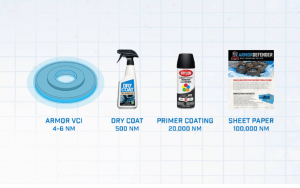
So, what is nanotechnology specifically? According to U.S. National Nanotechnology Initiative, Nanotechnology is the understanding and control of matter at the nanoscale (dimensions between 1 and 100 nanometers), where unique phenomena enable novel applications.
Thickness ranges between 4 – 6 nanometers (2 to 3 molecules thick)
Compare this to:
The adsorption process is not instantaneous. It requires time to form the inhibitor layer.

Contact sales@armorvci.com.au for more info.
Why is rust a problem in the marine and export industry?
The harsh marine climate brings with it extremely high salt and moisture levels, these highly concentrated levels cause significant corrosion to steel, infrastructure and assets in or around marine environments.
If corrosion is left untreated, it will eat away the structural integrity of metal, whether it be a boat, a storage shed, a building or a car.
It has been estimated that the total cost of marine corrosion worldwide is between $50-$80 billion every year (Maritime Industry), even energy companies are in a constant battle against corrosion, with the effects of corrosion causing huge financial costs.
Once corrosion or ‘rust’ sets in the strength of metal gradually weakens and becomes brittle, thus leading to expensive repairs or potential accidents if the metal is left untreated.

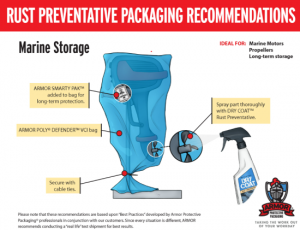
How can Armor help?
For more than 35 years, ARMOR has offered a full line of protective packaging products that include paper, poly film and desiccants infused with our proprietary vapor corrosion inhibiting (VCI) Nanotechnology. Our Metal Rescue and Dry Coat products are liquids designed to remove rust and prevent its return.
Our products protect all metal parts from corrosion or rust by surrounding the exposed metal with a protective barrier of VCI. Boat parts, motors, fishing tackle, storage sheds, tools, pipes, car parts, gates and building structures can be protected from the costly effects of corrosion by choosing the most appropriate products from our range.
All ARMOR products are clean, safe, easy to use, and extremely effective.
Not sure which product is right for your project? Give our team a call today for a suitable solution: 02 9524 5236 or e-mail us at: sales@armorvci.com.au

Wishing everyone a safe and enjoyable holiday season!
We look forward to assisting you on our return, Tuesday 2nd January 2024

Holiday closure dates Friday 22nd December to Tuesday 2nd January
02 9524 5236 or e-mail us at: sales@armorvci.com.au